Real Estate - Consolacion (Cebu)
Are you looking for a property to develop a:
-
language school
-
call center
-
private movie studio
-
medical center - clinic
-
spritual center
-
home for your family
-
Software Company Campus
-
Corporate conference centre
-
Executive family compound
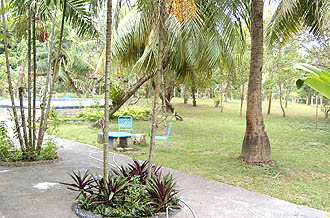
This 1
hectare private compound is quietly away from the bustle of Cebu City.
With 500 sq.m. of residence/office space and plenty of room for expansion.
A sit-in swimming pool to cool off, relax and think.
A park-like garden to walk and talk in and turn on the creativity.
Convenient to Cebu International Airport.
Security
- A 6-7 ft. Concrete Wall topped with glass and pleasantly covered with impenetrable
Bougainvillea surrounding the entire property.
- Two level gatehouse.
- Entry gates of heavy gauge marine steel.
PLUS
-
Circular driveway paved with firebricks
-
Large additional paved areas
-
Hawaiian blue grass lawn
-
Many species of fruit trees such as Jackfruit, Avocado, Cacao, Guyabano, lime trees,
Chiko, Pomegranate, Atis, Bananas, Coconuts, Tambis, Duhat, Siniguelas, Guavas,
Iba, etc. -
42 species of orchids
-
Large collection of flowering and fragrant trees
-
Landscaped pathways
-
Irrigation piping system
-
Concrete ponds
-
Gently sloping fully drained site
-
Town Water connection.
-
Guest cottage Japanese style.
-
Staff quarters.
-
Swimming pool.
-
cable TV (subscribe yourself).
-
Water tower.
-
3 car garage plus storage.
-
10,000 liter rainwater tank.
Main building; 500 sq.m., single level, solid steel frame stone block construction, huge central space, 4 large rooms with ensuite bathrooms, tile floors throughout, 3 phase power.